How to Train for Your First 5K: An 8-Week Plan for Complete Beginners
The week-by-week plan that takes you from walk-run intervals to crossing your first 5K finish line.
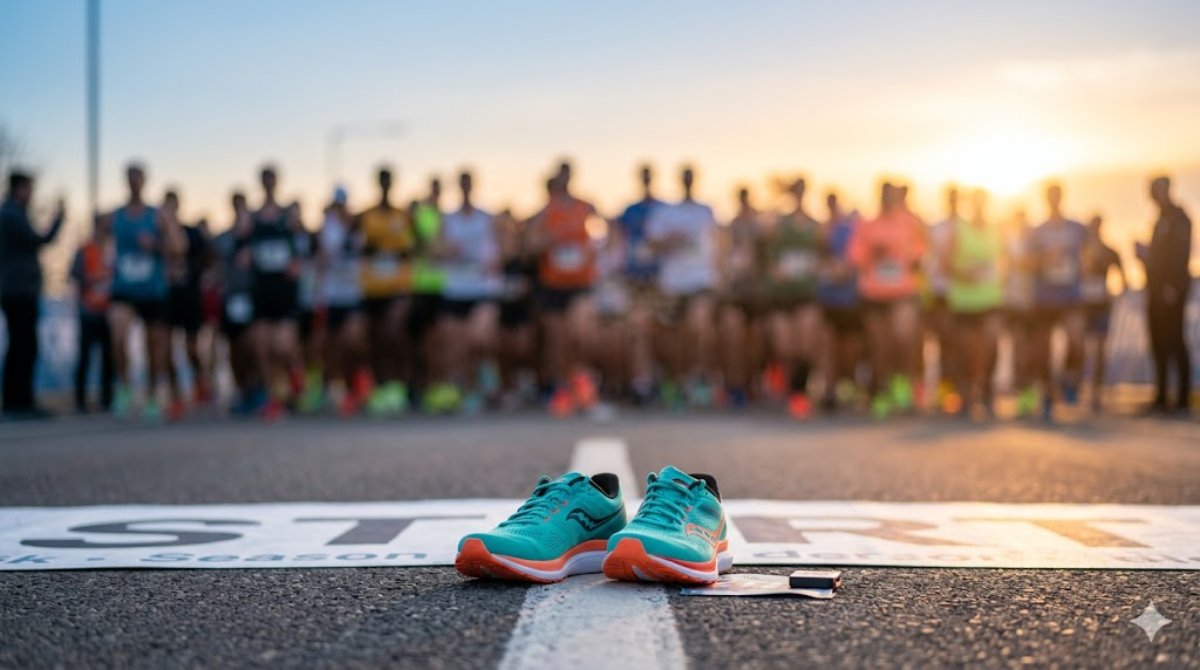
A 5K is the perfect first running goal. It's short enough to feel achievable inside 8 weeks of training, but long enough to require real preparation and deliver a genuine sense of accomplishment. Most beginners finish their first 5K in 25–40 minutes, often with a few walk breaks, and almost always feeling like they just crossed the line at an Olympic final.
That first 5K tends to be a turning point. It often leads to 10Ks, half marathons, and longer distances - though there's no need to think about any of that yet.
If you're ready to run your first 5K, here's the 8-week plan that works.
1. Why 5K is the perfect first goal
A 5K is 3.1 miles or roughly 5 kilometres. For most beginners, that translates to 25-40 minutes of running. It's short enough to be achievable within weeks, but long enough to require genuine training and give you a real sense of accomplishment.
It's also the most popular race distance in the world. Parkrun alone hosts free 5K events in dozens of countries every Saturday morning. Signing up for one gives you a deadline, a community, and a finish line to cross.
The 5K is where running stops being exercise and starts being a part of your identity. It's the distance that turns "I'm trying to run" into "I'm a runner."
2. Before you start: the basics
You need running shoes that fit properly - head to a running store and get fitted if possible. Beyond that, comfortable clothes and a way to track your runs (phone app is fine) is all you need.
You should be able to walk briskly for 30 minutes without discomfort before starting this plan. If you can't, spend 2-3 weeks building up your walking first. There's no rush.
If you haven't read it yet, the complete beginner's guide to running covers gear, mindset, and getting started in detail.
3. The 8-week plan
This plan uses three runs per week (e.g., Tuesday, Thursday, Saturday). Each session is 30 minutes. On non-running days, rest or do light activity like walking, cycling, or yoga.
Week 1 - Building the Foundation
Run 1 min, walk 4 min. Repeat 6 times. (30 min total)
Do this for all 3 sessions. Focus on running at a comfortable, conversational pace.
Week 2 - Finding Your Rhythm
Run 2 min, walk 3 min. Repeat 6 times. (30 min total)
You're doubling your run time from Week 1. It should feel manageable.
Week 3 - Turning a Corner
Run 3 min, walk 2 min. Repeat 6 times. (30 min total)
This is the week where many beginners start to feel like runners.
Week 4 - Equal Split
Run 4 min, walk 1 min. Repeat 6 times. (30 min total)
Your walk breaks are now just recovery breathers, not rest stops.
Week 5 - The Breakthrough
Session 1: Run 5 min, walk 1 min. Repeat 5 times.
Session 2: Run 8 min, walk 2 min. Repeat 3 times.
Session 3: Run 10 min, walk 2 min, run 10 min, walk 2 min, run 6 min.
Week 6 - Building Endurance
Session 1: Run 12 min, walk 1 min, run 12 min, walk 1 min, run 5 min.
Session 2: Run 15 min, walk 1 min, run 15 min.
Session 3: Run 20 min continuous (if comfortable).
Week 7 - Almost There
Session 1: Run 25 min continuous.
Session 2: Easy 20 min run (slow pace).
Session 3: Run 30 min continuous - you can cover 5K at this point!
Week 8 - Race Week
Session 1 (Mon/Tue): Easy 20 min run.
Session 2 (Wed/Thu): Easy 15 min run. Rest Friday.
Session 3 (Saturday): YOUR 5K! Run at a comfortable, steady pace. Walk if you need to.
4. Pacing: the most important rule
Run slower than you think you should. This applies to every single session in this plan. If you can't hold a conversation while running, slow down. If you're breathing so hard you can't speak a full sentence, slow down more.
Beginners almost always run too fast. Your body needs time to build an aerobic base, and that only happens at easy effort levels. A slow 5K finish is infinitely better than burning out at 2K.
5. Race day tips
Don't try anything new. Wear the shoes and clothes you've been training in. Eat what you normally eat. This is not the day for experiments.
Start at the back. There's no shame in positioning yourself toward the rear of the pack. It prevents you from going out too fast because everyone around you will be racing.
Run your own race. Ignore the runners sprinting past you in the first kilometre. Many of them will slow down later. Settle into your trained pace and stay there.
It's okay to walk. Seriously. If you need a walk break, take one. A 5K with walk breaks still counts as a 5K. You're still a runner.
Crossing your first 5K finish line is a feeling you'll remember forever. It doesn't matter how long it takes - you did something most people never attempt.
6. What comes after 5K
Once you've finished your first 5K, give yourself a week of easy running to recover and celebrate. Then you have options: try to get faster at 5K, build up to 10K, or just keep running 5Ks for the joy of it.
If you want to keep progressing, an AI-powered training plan can build on your 5K fitness and guide you toward your next goal - whether that's a faster 5K, a 10K, or eventually a half marathon.
And if you're curious about where the journey can eventually lead, I wrote about going from 5Ks to ultramarathons in my ultramarathon guide.
Build a 5K plan from your Strava history
The Running Genie reads your existing runs and generates an 8-week 5K plan tuned to your current fitness. Free to preview Week 1 - Pro unlocks the full plan.


The 8-week plan above has worked for hundreds of beginner runners. It's not magic - it's progressive overload, adequate rest, and the patience to let your body adapt. Follow it consistently and you will run 5K. That's not motivational fluff; it's physiology.
The only thing standing between you and your first 5K finish line is eight weeks of showing up.
Every marathoner, every ultrarunner, every Olympic athlete - they all started with a first 5K.
