Plantar Fasciitis in Runners: Causes, Treatment, and Prevention
Plantar fasciitis is one of the most common - and most poorly treated - overuse injuries in distance running. A research-backed guide to what actually drives the condition, what heals it, and what to do when running has to continue anyway. Educational content, not medical advice.
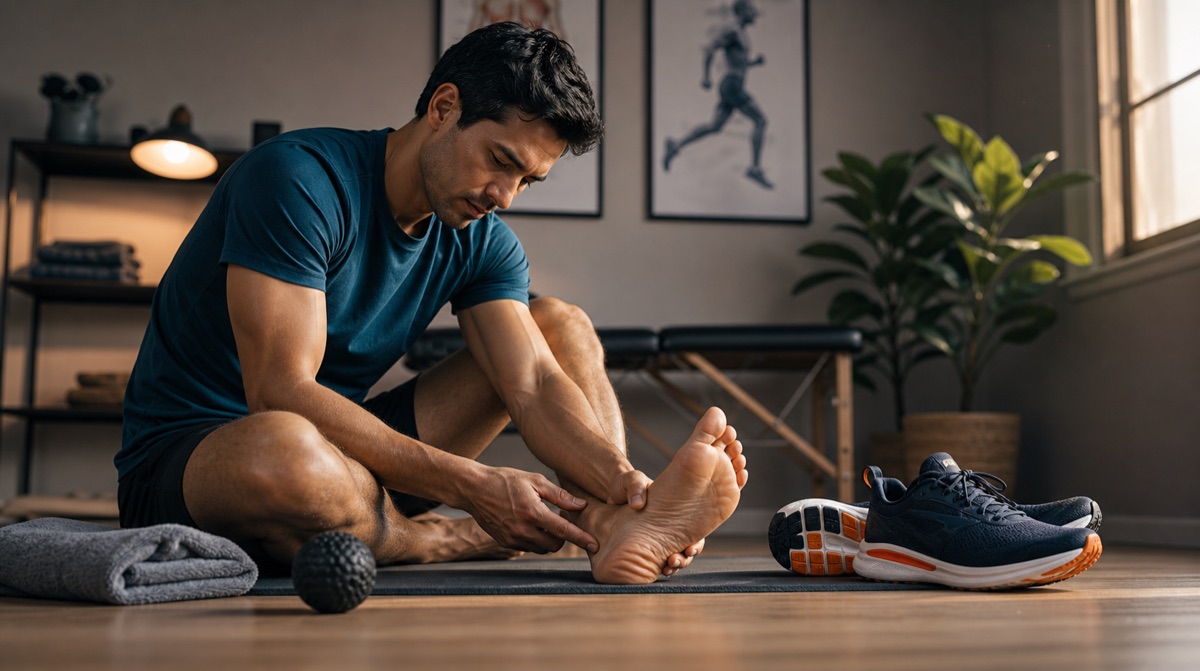
Plantar fasciitis is the sharp heel pain that hits with the first steps out of bed in the morning. It eases after walking around. It returns after sitting at a desk all day. It often improves during a warm-up run, then comes back worse the next morning. For runners, it ranks alongside runner's knee and IT band syndrome as one of the three most common overuse injuries - affecting roughly 10% of runners at some point in their career.
It is also one of the most poorly treated. The standard advice - rest, ice, stretch the calves, get an orthotic - produces inconsistent results and frequent recurrence. Newer protocols built around tendon loading, not rest and passive treatment, show better outcomes in controlled trials.
This guide covers what plantar fasciitis actually is, the evidence-supported treatment protocol, what to do about running during recovery, and how to prevent recurrence. None of this is medical advice - anyone with persistent heel pain should see a sports physiotherapist or podiatrist before self-treating beyond a few weeks.
What plantar fasciitis actually is
The plantar fascia is a thick band of connective tissue running along the bottom of the foot, from the heel bone (calcaneus) to the base of the toes. Its job is mechanical: it acts like a tensioned cable that supports the arch during weight-bearing and stores and releases elastic energy during walking and running.
The condition called "plantar fasciitis" was historically thought to be inflammation of this tissue (hence the "-itis" suffix). Modern imaging studies have largely contradicted that. Biopsies of chronic plantar fasciitis cases show degenerative tissue change - collagen disorganisation, microtearing, and abnormal vascular response - not classic inflammation. The clinically more accurate term is plantar fasciopathy, though "fasciitis" remains in everyday use.
This distinction matters because it changes what treatments make sense. Anti-inflammatory drugs and cortisone injections target inflammation that mostly isn't there; they often provide short-term pain relief without addressing the underlying degenerative process - and may actually delay healing in some cases.
The classic symptom pattern:
- Sharp heel pain (usually the inner front of the heel pad)
- Worst in the first 10–20 steps after waking
- Improves with light activity then returns after prolonged sitting
- May ease during running but worsen significantly after
- Pressing the inner-front aspect of the heel reproduces the pain
What causes it
Plantar fasciitis develops when load on the fascia exceeds the tissue's adaptive capacity. The causes are almost always combinations of these factors:
- Sudden mileage increases. The most common single trigger. A 25%+ jump in weekly distance over a short window often precedes plantar fasciitis onset.
- Weak calf and intrinsic foot muscles. The fascia takes on more load when the surrounding musculature can't share it. Weak calves and weak foot intrinsics are consistently associated with onset.
- Limited ankle dorsiflexion. Reduced upward range at the ankle increases the strain placed on the fascia with each step.
- Long periods of standing on hard surfaces. Sustained standing - particularly on concrete - accumulates fascia loading without the cyclic recovery running provides.
- Body weight above a typical range. Higher loading per step proportionally raises fascia strain.
- Shoe transitions. Switching to minimalist or low-drop shoes without progressive adaptation is a common precipitating factor.
Running form, foot type (high vs low arch), and "pronation" status historically dominated the plantar fasciitis literature. The current evidence is much more nuanced - none of these factors reliably predicts who will develop the condition. The most predictive factors are training load and tissue strength.
The high-load slow exercise protocol
The treatment with the strongest controlled-trial evidence is high-load slow heel raises with toes elevated. A 2014 study by Rathleff et al., published in the Scandinavian Journal of Medicine & Science in Sports, compared this loading protocol against standard plantar fascia stretching in patients with chronic plantar fasciitis. The loading group showed significantly faster pain reduction and functional improvement.
The protocol:
Heel raise with toes extended
Setup: Stand on a step or sturdy book with a rolled towel under the toes, so the toes are extended upward (dorsiflexed). The ball of the foot is on the elevated surface; the heel can drop below the surface level.
Movement: Single-leg heel raise. 3 seconds up, 2 seconds pause at the top, 3 seconds down. Slow and controlled throughout.
Volume: 3 sets of 12 reps per leg, every other day. Initially bodyweight; add load (backpack with books) as pain reduces.
Expected timeline: Meaningful pain reduction at 6–8 weeks. Continued improvement through 3–6 months.
The mechanism: this loading protocol stresses the plantar fascia and the calf complex in their stretched, weighted position - exactly the conditions where the tissue needs adaptive remodeling. Slow tempo work places sustained tension on the fascia, which appears to drive collagen reorganisation more effectively than passive stretching alone.
Importantly, this loading protocol can be uncomfortable during the exercise (up to 4/10 pain) without compromising recovery - controlled studies have established that some discomfort during loading is acceptable and does not slow healing. Pain above 5/10 indicates the load is too heavy or the volume too high.
What else has evidence behind it
Supplementary treatments with reasonable evidence support:
Calf strengthening more broadly. Heavy single-leg calf raises (not necessarily with toes elevated) strengthen the soleus and gastrocnemius. These muscles share load with the fascia. A 2018 trial in the British Journal of Sports Medicine showed combined plantar-specific and general calf loading produced better outcomes than either alone.
Frozen-bottle rolling. Rolling the foot over a frozen plastic water bottle for 5–10 minutes provides combined ice and mobilisation. Short-term pain relief is well-documented; the long-term healing effect is small but real.
Night splints. A boot or splint worn overnight that keeps the foot in slight dorsiflexion. The mechanism: keeping the fascia at a mild stretch overnight reduces the morning stiffness that drives much of the daily pain pattern. Evidence is moderate - useful for many sufferers, particularly during the highest-pain phase.
Massage and mobilisation. Targeted soft tissue work on the calf and plantar fascia produces short-term symptom relief. Not curative on its own but useful as an adjunct.
Taping. Low-Dye taping or similar protocols provide short-term mechanical support. The evidence is mixed but the practical value is real for runs that need to happen during recovery - taping often allows easier running with lower pain.
Heel cups and arch supports. Off-the-shelf heel cushions or supportive inserts produce short-term symptom reduction in many cases. The evidence does not support custom orthotics over standard cushioned inserts for most plantar fasciitis cases - saving the runner significant cost.
Treatments with weaker evidence: corticosteroid injections (short-term relief, but data on long-term outcomes is mixed, and there is risk of fascia rupture with repeated injection), extracorporeal shock wave therapy (helpful for chronic cases that haven't responded to other treatment, less useful in acute cases), PRP injections (some evidence in chronic cases, expensive, requires specialist).
For broader injury prevention principles that apply here, see how to prevent common running injuries.
Can you keep running with plantar fasciitis?
The honest answer: sometimes. The decision depends on pain level, response patterns, and stage of the condition.
When continued running is reasonable
Pain stays at or below 3/10 during the run.
Pain does not significantly worsen in the hours after the run.
Morning pain is stable or improving week to week.
No limp or altered gait during the run.
When running should pause or significantly reduce
Pain rises above 3/10 during the run.
Pain is meaningfully worse in the 24 hours after running.
Morning symptoms are getting worse week to week.
Gait is altered - limping, favouring the affected foot.
For runners who can continue running:
- Reduce weekly volume by 30–50% during the worst weeks
- Drop all intensity work - easy running only
- Run on softer surfaces (trail, grass, treadmill) where possible
- Substitute affected sessions with low-impact cross-training: cycling, pool running, elliptical (see cross-training for runners)
- Build the loading protocol into the weekly schedule on non-running days
The wrong instinct: pushing through accelerating morning pain because the run itself "felt okay." Plantar fasciitis often feels better during running (the warmed-up fascia is more compliant) and dramatically worse afterward. The morning pain trend is the more reliable indicator than the in-run feel.
The chronic case: when standard treatment isn't working
Most plantar fasciitis cases resolve in 3–6 months with the loading protocol and supplementary management. About 10–15% of cases become chronic - persisting beyond 6–12 months. For these cases, the options expand:
Extracorporeal shock wave therapy (ESWT). Focused or radial shock waves applied to the heel, typically across 3–5 sessions. Multiple controlled trials show meaningful improvement in chronic cases that have failed conservative treatment. Available through sports medicine clinics.
Platelet-rich plasma (PRP) injections. Patient's own blood, processed to concentrate growth factors, injected at the fascia. Evidence in chronic cases is moderate; expensive and requires specialist administration.
Specialist gait and footwear assessment. Some chronic cases reflect a movement pattern or biomechanical factor that isn't visible to general protocols. A sports physiotherapist with running specialty experience may identify factors that targeted intervention can address.
Surgery. A last resort. Plantar fascia release procedures exist but have mixed outcomes and substantial recovery time. Reserved for cases that have failed all conservative treatment over 12+ months.
Footwear during plantar fasciitis
Some practical points on shoes during recovery and beyond:
- Avoid going barefoot at home during acute phases. The unsupported foot loading first thing in the morning is what produces the worst pain. Slip-on shoes with a heel cushion at the bedside help.
- Don't switch to maximally cushioned shoes overnight. Sudden drop changes (e.g., from a 8 mm drop to a 0 mm drop, or vice versa) often aggravate the condition. Stick close to current shoe characteristics during recovery.
- Heel-to-toe drop has some effect. Higher-drop shoes (10–12 mm) reduce calf and fascia stretch with each step. Many runners with active plantar fasciitis find higher-drop shoes more comfortable. After recovery, gradual transition back to preferred drop is fine.
- Replace worn shoes. A shoe that has lost its cushioning increases fascia loading. If pain coincides with shoes nearing 600+ km, replacement may help.
The Running Genie — AI training plans that adapt around injuries and recovery, not push through them. Free to download.
Preventing recurrence
Once plantar fasciitis has occurred, the risk of recurrence is meaningfully elevated for the next 12–24 months. Several preventive habits substantially reduce that risk:
- Continue the loading exercise even after pain resolves. Two heel raise sessions per week, with progressive load, maintains the tissue resilience that drove recovery. Many physiotherapists recommend continuing for 6–12 months post-recovery.
- Build calf and foot intrinsic strength. Heavy calf work and foot intrinsic exercises (toe spreads, short-foot exercises, foot doming) build the surrounding capacity that takes load off the fascia.
- Respect the 10% rule on weekly mileage. Avoid weekly distance jumps over 10–15%. The training error that often precipitates plantar fasciitis is sudden volume increase, particularly after time off.
- Vary running surfaces. Some softer-surface running each week reduces cumulative loading.
- Maintain ankle dorsiflexion. Calf stretching, ankle mobility drills, and avoiding extended periods of plantarflexed positions (high heels, prolonged seated foot positions) preserve the ankle range that protects the fascia.
What not to do
Don't rest passively for weeks. Complete rest provides short-term pain relief and almost certain recurrence. The fascia adapts only under load. The loading protocol works during recovery, not after.
Don't stretch aggressively. The "calf stretch on the wall" is sometimes prescribed but is the lower-evidence option. The high-load eccentric work is more effective. Stretching can be a gentle adjunct, not the primary intervention.
Don't chase too many simultaneous interventions. Trying loading, taping, night splints, ice, ESWT, orthotics, and shoe changes all at once makes it impossible to know what is helping. Add one or two interventions at a time, give them 4–6 weeks, then adjust.
Don't take an NSAID and keep training the same volume. Pain reduction from anti-inflammatory drugs is real but the underlying tissue is unchanged. Continuing to load the fascia at full volume while masking pain is a path to chronic dysfunction.
Don't skip the morning routine. A 5-minute foot mobilisation before getting out of bed - ankle circles, gentle plantar fascia massage with thumbs, toe scrunches - meaningfully reduces the morning pain that defines the daily experience of the condition.
When to see a specialist
The general rule: if conservative self-management with the loading protocol has not produced clear improvement within 6–8 weeks, see a sports physiotherapist or podiatrist. Persistent symptoms beyond that window benefit from professional assessment - both to rule out related conditions (stress fracture of the calcaneus, fat pad atrophy, nerve entrapment) and to refine the protocol for the specific case.
Red flags that warrant earlier specialist consultation:
- Sudden onset of severe heel pain rather than gradual development
- Pain that worsens with all weight-bearing, not just first steps
- Visible swelling or warmth at the heel
- Numbness or tingling in the heel or foot
- Inability to rise on the toes of the affected foot
These symptoms can indicate stress fractures, tendon ruptures, or nerve issues that need different treatment than plantar fasciitis.
Plantar fasciitis is durable but recoverable. The single biggest improvement in treatment over the past decade has been the shift from "rest and stretch" to "load slowly and heavily." The fascia is connective tissue; like other connective tissue, it adapts to controlled progressive load and stagnates without it.
For most runners, the recovery path looks like: confirm the diagnosis, start the heel raise protocol immediately, reduce running volume if needed, address any obvious triggers (mileage spike, shoe change, body weight change), be patient. Three to six months is the realistic timeline. The patience requirement is real.
The single most useful habit a runner can build to prevent recurrence: continuing weekly heavy calf and plantar-specific loading even after symptoms resolve. The fascia that healed under load also stays resilient under load.
Load the tissue. Don't rest it. Patience and protocol beat pills and passive treatment.
