Why Every Runner Should Keep a Training Log (And What to Actually Track)
A simple training log changes how runners train - not through any single entry, but through the patterns that emerge after months of consistent logging.
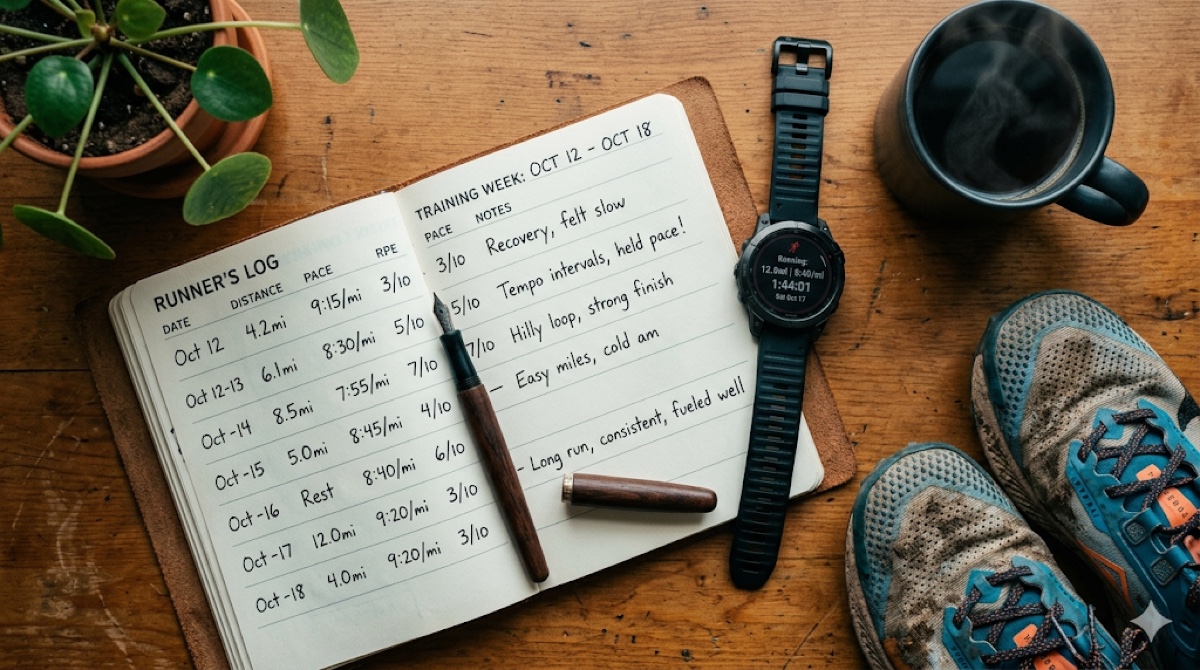
A training log changes how a runner thinks about running. Not because of any single entry, but because after months of consistent logging, patterns emerge that would be invisible without the data. A runner might discover, for example, that after more than four hard sessions in a ten-day window, a niggle reliably shows up the following week. Without the log, those injuries feel random. With it, they become predictable - and therefore preventable.
A training log is the most underrated tool in running. Not a GPS watch, not a heart rate monitor, not an expensive app - though those can all feed into it. The log itself. The simple act of recording what you did, how it felt, and what was happening in your life around the training.
Why logging works: the power of patterns
Your memory is terrible. Not as an insult - everyone's is. You can't accurately remember how you felt on a Tuesday run three weeks ago, or what your sleep was like the night before your best tempo run, or whether that persistent calf tightness started before or after you increased your weekly distance. Your brain smooths out the details, keeps the highlights, and discards the nuance.
A training log captures the nuance. And the nuance is where the insights live.
Over weeks and months, logged data reveals patterns that are invisible in real time: which training blocks preceded your best races, how much recovery you need after long runs, whether strength training actually correlates with fewer injuries (spoiler: it usually does), and when your body starts showing signs of overtraining before you consciously feel overtrained.
A training log doesn't make you faster. It makes you smarter. And smarter runners waste fewer weeks on mistakes they could have predicted.
What to track (the essentials)
The biggest mistake runners make with logging is trying to track everything. Twenty data points per session is not sustainable, and most of the data won't be useful. Here's what actually matters:
The basics: Date, distance, duration, and average pace. These are the minimum - and for many runners, they're automatically captured by a GPS watch or app. This data lets you track volume over time, which is the single most important number in your training.
Effort/RPE (Rate of Perceived Effort). This is the most undervalued metric in running. After every run, rate it on a simple 1-10 scale. How hard did it feel? This subjective measure captures something your watch can't - your internal state. When your easy runs start feeling hard (RPE creeping up at the same pace), it's an early warning signal of accumulated fatigue, well before your pace or heart rate shows it.
Workout type. Was it an easy run, tempo, intervals, long run, or recovery? Tracking this lets you see your hard/easy ratio over time. Most runners should be at roughly 80% easy, 20% hard. If your log shows you're at 60/40, you've found one reason you're not improving.
How you felt. A brief note - even just a word or two. "Legs heavy." "Felt strong." "Left knee tight after 8K." "Stressed from work, run felt harder than it should." This qualitative data is often more useful than the quantitative data because it captures context that numbers miss.
Sleep. Hours and quality (good/okay/poor). This single metric correlates more strongly with running performance and injury risk than almost anything else in your training log. If you track nothing else beyond the basics, track your sleep.
The minimal viable training log (per session):
Distance + duration: Auto-captured by your watch/app
RPE (1-10): 5 seconds to enter
Workout type: Easy / tempo / intervals / long / recovery
One-line note: How you felt, any niggles, life context
Sleep last night: Hours + quality
Total time to log: under 60 seconds.
What to track (the nice-to-haves)
Heart rate data. Average and max heart rate for the session. Useful for tracking cardiac drift over time and validating that your easy runs are actually easy. Your watch captures this automatically - the value is in reviewing the trends, not the individual sessions.
Strength and cross-training. Did you do a strength session? Yoga? Cycling? Tracking these activities alongside your running helps you see whether your cross-training is actually contributing to better running or just adding fatigue.
Weight (weekly, not daily). Useful for catching unintentional weight loss during heavy training blocks, which can indicate under-fuelling. Don't track daily - normal hydration fluctuations make daily weigh-ins meaningless and potentially anxiety-inducing.
Resting heart rate (morning). A rising resting heart rate over several days is one of the earliest indicators of overreaching or illness. Many modern watches track this automatically.
What NOT to obsess over
This is equally important. Some data, while interesting, can become counterproductive if you pay too much attention to it:
Daily pace on easy runs. Your easy run pace will vary by 30-60 seconds per kilometre depending on temperature, sleep, stress, terrain, and a dozen other factors. Comparing today's easy run pace to last Thursday's is meaningless. Look at the trend over months, not individual sessions.
Strava comparisons. Your training log is for you. Not for comparing yourself to others, not for chasing segment PRs on recovery runs, not for validating your worth as a runner. The moment your log becomes a performance scorecard for social media, it stops being useful for training.
Cadence, ground contact time, vertical oscillation. These metrics exist because watches can measure them, not because tracking them makes you faster. Unless you're working on a specific form issue with a coach, these numbers add noise without insight.
The data-feel balance
Here's the philosophical tension at the heart of training logging: data should inform your decisions, not make them. The log tells you what happened. Your body tells you what to do about it.
The best runners use data to confirm what they already suspect from how they feel. If your RPE has been creeping up and your log confirms that your volume jumped 15% in two weeks, you have a clear signal to back off. But if the data says everything is fine and your body says something is wrong, trust your body. Numbers don't feel. You do.
An AI training plan can automate much of this analysis - tracking your volume trends, flagging when your easy pace is drifting too hard, and adjusting your plan when the data suggests you need more recovery. But even with AI, the subjective notes in your log capture something algorithms can't: the lived experience of your training.
Starting your log
Don't overthink the format. A simple spreadsheet works. A notes app works. The Running Genie captures most of the quantitative data automatically. What matters is that you do it consistently - even imperfect logging done every day beats a perfect system you abandon after two weeks.
Start with the minimal viable log (distance, RPE, note, sleep) and add complexity only if you find yourself wanting more data. Most runners find that the basics are more than enough.
The best coaches in the world keep meticulous logs of their athletes' training - not because they're obsessive, but because the patterns in the data reveal truths that day-to-day experience obscures. You don't need a coach to benefit from this. You just need the discipline to write it down and the patience to look back.
Your training log is a letter from your past self to your future self. Make it worth reading.
Track less, but track it every day. The power of a training log isn't in the data - it's in the consistency.
The Running Genie — AI training plans that read your training history and adapt the next run. Free to download.
